Flat Tire in Winter? Emergency Tire Change Guide for Mississauga Drivers
You’re driving down the QEW near Port Credit on a frigid January evening when you hear it—that unmistakable thump-thump-thump of a flat tire. Your heart sinks as you realize you’ll need to change it in sub-zero temperatures, on icy pavement, in the dark. Or worse, you walk out to your car in a snow-covered Erin Mills parking lot and discover your tire is completely flat before you’ve even started your day.
Flat tires are frustrating any time of year, but winter conditions in Mississauga make them particularly challenging and potentially dangerous. Between frozen lug nuts, icy ground that makes jacks unstable, reduced visibility, and the risk of frostbite, changing a tire in winter requires extra caution—and sometimes, professional help is the only safe option.
At Mississauga Towing, we provide emergency tire change service 24/7 across all of Mississauga. This comprehensive guide covers everything you need to know: how to safely change a tire in winter conditions, when it’s too dangerous to attempt it yourself, and how our mobile tire service can get you back on the road quickly and safely.
Common Causes of Winter Flat Tires in Mississauga
Understanding why flats happen more frequently in winter can help you prevent them—or at least know what to watch for during the coldest months .
Pothole Damage
Mississauga’s roads take a beating every winter. The freeze-thaw cycle creates potholes that seem to appear overnight, especially on heavily traveled routes like Hurontario Street, Dundas Street, and the Queensway. Hitting a pothole at speed can cause immediate tire damage—sidewall bulges, punctures, or even bent rims that cause slow leaks. In extreme cases, you’ll hear the tire blow out instantly.
Pothole season typically peaks in late February through March, but damage can occur any time temperatures fluctuate around freezing.
Reduced Tire Pressure from Cold Temperatures
For every 5°C drop in temperature, your tires lose approximately 1 PSI (pound per square inch) of air pressure. When Mississauga temperatures plummet from 5°C to -20°C overnight—a common occurrence in January—your tires can lose 5 PSI or more. Underinflated tires are more vulnerable to punctures, sidewall damage, and blowouts, especially when driving over rough winter roads or highway debris.
Many drivers don’t realize their tires are underinflated until it’s too late. Modern vehicles have Tire Pressure Monitoring Systems (TPMS) that trigger a warning light when pressure drops significantly, but by that point, damage may already be occurring.
Road Debris and Sharp Objects Hidden in Snow
Winter snow conceals road hazards—nails, screws, metal fragments, broken glass, and sharp debris from accidents. You can’t see what you’re driving over, and your tires pay the price. Construction debris on busy roads like Eglinton Avenue or near development sites in Meadowvale becomes invisible under fresh snow, turning routine drives into tire-puncture lottery.
Worn or Damaged Winter Tires
If you’re running winter tires that are several seasons old with worn tread, or if you’re still using all-season tires (which shouldn’t be used in Canadian winters), you’re at higher risk for flats. Worn tires have thinner rubber that’s more easily punctured, and they provide less protection against impacts from potholes and curbs.
Curb Strikes and Parking Lot Incidents
Snow banks obscure curbs, parking lot barriers, and concrete wheel stops. It’s easy to misjudge distances when parking in snow-covered lots at Square One, Cooksville GO Station, or your condo building. Hitting a hidden curb or barrier can damage your tire’s sidewall, causing slow leaks or immediate failure.
Signs You Have a Flat Tire (Beyond the Obvious)
Not all flat tires are immediately obvious, especially slow leaks. Watch for these warning signs:
- Pulling to one side: If your vehicle drifts left or right while driving straight, one tire may be significantly underinflated.
- Vibration or thumping sound: A rhythmic thumping that increases with speed indicates a flat or severely damaged tire.
- TPMS warning light: Your dashboard displays a tire pressure warning (often shaped like a tire cross-section with an exclamation mark).
- Difficulty steering: A flat front tire makes steering feel sluggish and unresponsive.
- Visual inspection: If your tire looks visibly deflated, has bulges in the sidewall, or you can see objects embedded in the tread, you have a problem.
If you experience any of these while driving, don’t ignore them. Pull over safely as soon as possible to inspect your tires. Continuing to drive on a flat tire will destroy the tire completely and can damage your wheel rim, costing you hundreds of dollars more in repairs.
Immediate Steps When You Get a Flat Tire in Winter
Your first actions determine whether you’ll resolve this safely or turn a flat tire into a dangerous situation. Follow these steps:
1. Get to a Safe Location
If you’re on a highway (401, 403, QEW, or major roads like Burnhamthorpe or Eglinton), do not stop on the shoulder unless absolutely necessary. Shoulders are extremely dangerous in winter—icy, narrow, and visibility is poor. If possible, take the next exit and find a well-lit parking lot, gas station, or side street.
If you must stop on a highway shoulder:
- Pull as far right as possible, away from traffic lanes
- Turn on your hazard lights immediately
- Stay inside your vehicle with your seatbelt on
- Call for professional help rather than attempting a roadside tire change in traffic
For parking lot flats, position your vehicle on the flattest, most level surface available, away from traffic flow.
2. Assess the Weather and Lighting Conditions
Changing a tire in winter isn’t just about mechanical steps—it’s about evaluating safety conditions. Ask yourself:
- Is it dark? Can you see clearly to work safely?
- Is the ground icy or snow-covered, making it unstable for a jack?
- Is the temperature below -10°C, creating frostbite risk during the 20-30 minutes it takes to change a tire?
- Is it snowing heavily, reducing visibility and making you less visible to other drivers?
- Are you on a busy road where passing vehicles pose a collision risk?
If the answer to any of these is “yes,” the safest choice is to call for professional roadside assistance at 647-601-6377 rather than attempting a DIY tire change in hazardous conditions.
3. Determine if You Have the Proper Equipment
Check your trunk for:
- A spare tire (full-size or temporary “donut” spare) that’s properly inflated
- A working jack that can lift your vehicle
- A lug wrench that fits your wheel nuts
- Wheel chocks or heavy objects to prevent rolling
- Gloves (preferably insulated winter gloves)
- Flashlight or headlamp with working batteries
- Reflective triangle or road flares for visibility
Many vehicles come with emergency spare kits, but if you bought a used vehicle or haven’t checked in years, your spare might be flat, your jack might be missing, or your lug wrench might not fit. Don’t discover this after you’re already stranded in the cold.
How to Safely Change a Tire in Winter Conditions (DIY Guide)
If you’ve assessed the situation and determined it’s safe to proceed, follow these steps carefully. Winter adds complications to every stage of the process.
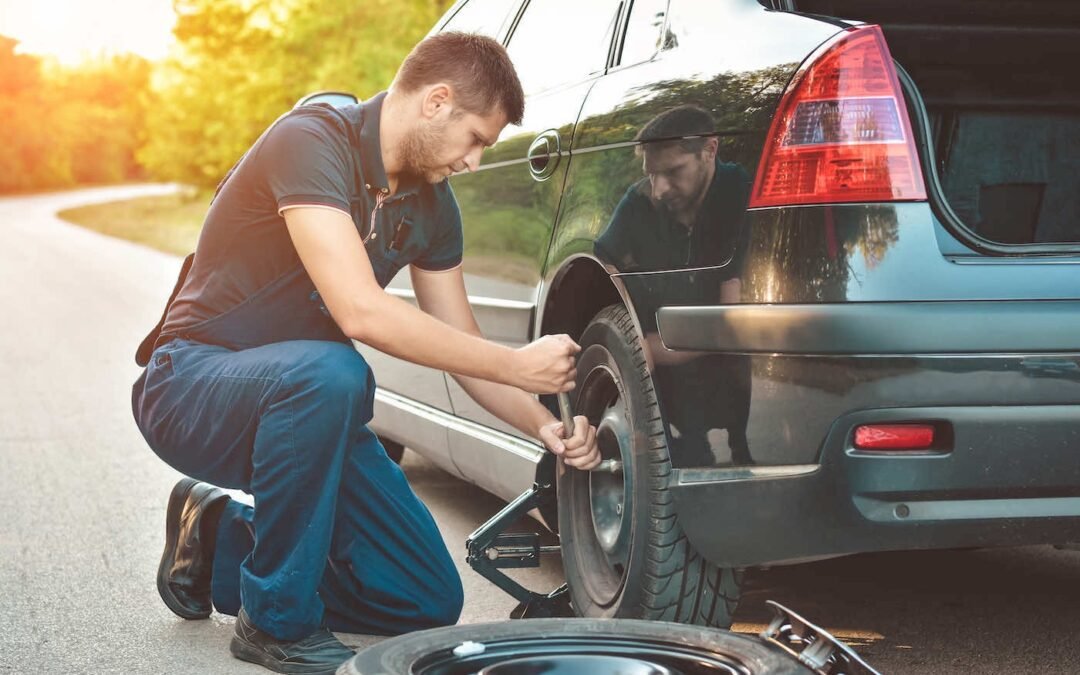
Step 1: Prepare Your Work Area
- Turn on hazard lights to alert other drivers.
- Apply the parking brake firmly.
- Place wheel chocks (or heavy rocks, bricks, or boards) in front of and behind the tire diagonally opposite the flat to prevent rolling. This is critical on icy or sloped surfaces.
- Put on your high-visibility vest or jacket if you have one, so you’re visible to traffic.
- Set up reflective triangles or flares 50-100 feet behind your vehicle to warn approaching drivers.
Step 2: Loosen the Lug Nuts (Before Jacking)
This is where winter makes things difficult. Cold temperatures cause metal to contract, and road salt corrosion can essentially “freeze” lug nuts onto wheel studs.
- Use your lug wrench to slightly loosen each lug nut while the tire is still on the ground (don’t remove them yet—just break them loose). Turn counter-clockwise.
- If lug nuts won’t budge, try:
- Using your body weight—step on the wrench handle (carefully) to apply more torque
- Applying penetrating oil (like WD-40) and waiting 5-10 minutes
- Using a breaker bar or extended wrench handle for leverage
- If lug nuts are completely seized or you’re not strong enough to loosen them, do not force it—you can strip the nut or break the stud. Call 647-601-6377 for professional tire service with impact tools.
Step 3: Position the Jack Safely
Winter ground conditions make this the most dangerous step. Ice and snow create unstable surfaces that can cause jacks to slip, potentially causing serious injury.
- Consult your vehicle’s owner’s manual to locate the proper jacking points (usually reinforced areas of the frame near each wheel).
- If you’re on snow or ice, place a wide, flat board or piece of plywood under the jack base to distribute weight and prevent sinking or slipping.
- Position the jack under the designated jacking point.
- Begin raising the vehicle slowly, checking that the jack remains stable and perpendicular.
- Raise the vehicle just high enough that the flat tire is 1-2 inches off the ground—no higher than necessary.
Critical Safety Warning: Never place any part of your body under a jacked vehicle. Jacks can fail, especially on unstable winter ground. If the vehicle falls, it can cause fatal injuries.
Step 4: Remove the Flat Tire
- Finish removing the loosened lug nuts completely. Place them in your pocket or a container so they don’t roll away into the snow.
- Grip the flat tire firmly with both hands and pull it straight toward you to remove it from the wheel hub.
- Lay the flat tire flat on the ground near your work area (not under the vehicle).
Step 5: Install the Spare Tire
- Lift the spare tire (it may be heavy—30-50 lbs) and align the holes in the wheel with the wheel studs on the hub.
- Push the spare tire onto the hub until it’s flush against the mounting surface.
- Hand-thread the lug nuts onto the studs in a star or criss-cross pattern (not in a circle) to ensure even seating. Tighten them by hand as much as possible.
Step 6: Lower the Vehicle and Tighten Lug Nuts
- Slowly lower the jack until the spare tire just touches the ground but isn’t yet bearing the full weight of the vehicle.
- Use the lug wrench to tighten the lug nuts firmly in a star pattern, applying even pressure. You want them snug, but don’t over-tighten yet.
- Lower the vehicle completely and remove the jack.
- Now fully tighten all lug nuts in the star pattern, using your body weight on the wrench if necessary. They should be very tight—you don’t want a wheel coming loose while driving.
Step 7: Stow Equipment and Check Spare Pressure
- Place the flat tire, jack, and lug wrench back in your trunk.
- Remove wheel chocks and reflective equipment.
- If possible, check the spare tire’s air pressure at the nearest gas station. Temporary “donut” spares should be inflated to 60 PSI (check the sidewall for the exact specification).
Step 8: Drive Safely to a Tire Shop
If you’ve installed a temporary “donut” spare:
- Drive no faster than 80 km/h
- Do not drive more than 100-120 km on a temporary spare
- Avoid sudden acceleration, hard braking, or sharp turns
- Get to a tire repair shop or home as soon as safely possible
Temporary spares are not designed for extended use, highway speeds, or winter road conditions. Treat it as exactly what it is—a temporary emergency solution.
When It’s Too Dangerous to Change Your Own Tire
There are many situations where attempting a DIY tire change in winter is simply too risky. Recognize these scenarios and call for professional help instead:
1. You’re on a Highway or High-Speed Road
Shoulders on the 401, 403, QEW, or busy roads like Hurontario Street and Dixie Road are extremely dangerous. Winter reduces visibility for approaching drivers, and vehicles can slide on ice and strike you. Distracted drivers may not see you in time. Highway shoulder tire changes account for hundreds of injuries and deaths across Canada each year.
Solution: Call for professional 24/7 emergency roadside service at 647-601-6377. Our drivers are trained in highway safety protocols, have proper lighting and safety equipment, and can often change your tire faster than you could yourself.
2. Severe Weather Conditions
If it’s snowing heavily, sleeting, or experiencing freezing rain, visibility is poor for both you and other drivers. Working with metal tools in these conditions also creates risks—metal conducts cold, leading to frostbite, and icy tools are difficult to grip safely.
Wind chill below -15°C creates frostbite risk within 10-15 minutes of exposed skin. Changing a tire typically takes 20-30 minutes. Factor in fumbling with frozen tools, struggling with seized lug nuts, and positioning a jack on slippery ground—you’re looking at 30-45 minutes of exposure.
Solution: Stay in your warm vehicle and call for help. Frostbite and hypothermia are serious medical emergencies that aren’t worth the risk of saving $100 on a service call.
3. Unstable or Icy Ground
If the ground is covered in ice, packed snow, or is significantly sloped, your jack can slip, causing the vehicle to fall. This can result in serious injury or death. Even seemingly stable ground can be deceptively slippery when frozen.
Solution: Professional tow trucks carry heavy-duty jacks, stabilizing boards, and equipment designed for unstable surfaces. We handle these situations daily and know how to work safely in conditions where consumer jacks would fail.
4. You’re Alone at Night
Changing a tire in the dark is challenging even in summer. In winter, darkness comes early (by 5 PM in January), and many Mississauga residential areas, parking lots, and side streets have poor lighting. Working without adequate light increases the risk of injury from tools, dropping lug nuts into snow where you can’t find them, or positioning the jack incorrectly.
Solution: Unless you have professional-grade lighting (headlamp, work lights), call for mobile tire change service. Our trucks are equipped with powerful work lights that illuminate the entire work area safely.
5. You Have Physical Limitations
Changing a tire requires significant physical strength—lifting a 30-50 lb spare tire, applying torque to frozen lug nuts, and working in awkward positions while crouching in cold weather. If you have back problems, limited mobility, or aren’t confident in your physical ability to complete the job, don’t risk injury.
Solution: There’s no shame in calling for professional help. That’s exactly what we’re here for. Call 647-601-6377 anytime, and we’ll have you back on the road safely.
6. Your Lug Nuts Are Seized or Damaged
If you’ve tried to loosen your lug nuts and they won’t budge, or if the wrench is stripping the nuts, stop immediately. Forcing it can break the wheel stud, making the repair far more expensive and time-consuming.
Solution: Our service trucks carry pneumatic impact wrenches that can remove even the most stubborn, corroded, or over-torqued lug nuts safely without damaging studs.
7. You Don’t Have a Spare or Proper Equipment
Many modern vehicles no longer come with spare tires—instead, they include tire repair kits or run-flat tires. If you don’t have a spare, or if your spare is flat (which happens more often than you’d think), you can’t complete a tire change.
Solution: We can either provide on-site tire inflation and repair (if the puncture is repairable), or tow your vehicle to a nearby tire shop or your home.
Mobile Tire Change Service vs. Towing to a Shop
When you call Mississauga Towing for a flat tire, we have two service options depending on your situation:
Option 1: On-Site Tire Change (Fastest Solution)
If you have a working spare tire, our technician can change it on-site within 15-20 minutes. This service is ideal when:
- You have a full-size spare or properly inflated temporary spare
- You need to get to work, an appointment, or home quickly
- The flat occurred in a safe location (parking lot, residential street)
- You want to drive to your preferred tire shop later
We carry all professional tools—impact wrenches, heavy-duty jacks, work lights, and safety equipment—to complete the job safely regardless of weather conditions. You stay warm in your vehicle while we handle everything.
Cost: Mobile tire change service is typically more affordable than towing, with transparent pricing provided upfront when you call.
Option 2: Flatbed Towing to Tire Shop or Home
If you don’t have a spare, or if your tire damage is severe (sidewall damage, multiple flats, wheel damage), we provide flatbed towing to your destination of choice:
- A tire repair shop in your area (we can recommend trusted local shops)
- Your home, so you can deal with repairs later
- A dealership if your vehicle is under warranty
Flatbed towing is especially important if you have an all-wheel-drive vehicle (like many SUVs and crossovers popular in Mississauga winters). Towing AWD vehicles with one tire missing or flat can damage the drivetrain—flatbed transport with all wheels off the ground prevents this issue.
Cost: Towing costs vary based on distance. We provide exact quotes before dispatch, with no hidden fees or surprises.
Common Winter Tire Damage Scenarios in Mississauga
Certain types of tire damage are unique to winter conditions. Here’s what we see most often across Mississauga neighborhoods:
Pothole Blowouts
Where it happens: High-traffic roads like Dundas Street, Burnhamthorpe Road, Lakeshore Road, and Eglinton Avenue develop potholes rapidly during freeze-thaw cycles.
What happens: Hitting a deep pothole at speed can cause instant tire failure—a loud bang, immediate deflation, and sometimes wheel rim damage (bent or cracked rims).
Solution: If the rim is damaged, you’ll need towing to a shop even if you have a spare. We can assess rim damage on-site and recommend the best course of action.
Slow Leaks from Embedded Debris
Where it happens: Construction zones, parking lots, residential streets with hidden debris under snow.
What happens: You drive over a nail, screw, or sharp metal fragment. It embeds in the tread and causes a slow leak—your tire gradually loses pressure over hours or days rather than instantly.
Solution: Many slow leaks are repairable by a tire shop using a plug or patch. However, if the puncture is in the sidewall or larger than 6mm, the tire must be replaced. We can inflate your tire temporarily to get you to a repair shop if the puncture is small and the tire still holds some air.
Sidewall Damage from Curbs
Where it happens: Snow-covered parking lots at Square One, Erin Mills Town Centre, Meadowvale Town Centre, condo complexes, and residential driveways where curbs are hidden.
What happens: You strike a hidden curb or concrete barrier, causing a bulge, cut, or tear in the tire’s sidewall. Sidewall damage is not repairable and requires immediate tire replacement.
Solution: Do not drive on a tire with sidewall damage—it can blow out catastrophically at highway speeds. Call for towing if you notice sidewall bulges or cuts.
Tire Bead Leaks from Ice and Corrosion
Where it happens: Common on older vehicles or wheels with corrosion, especially during extreme temperature swings.
What happens: The tire’s inner “bead” (where the tire seals against the wheel rim) develops a small gap due to rim corrosion, ice buildup, or temperature contraction. Air slowly leaks out through this gap.
Solution: This requires professional repair—the tire must be removed, the rim cleaned and sealed, and the tire remounted. Temporary inflation may get you to a shop, but it won’t fix the underlying issue.
Essential Winter Tire Emergency Kit
Being prepared can turn a minor inconvenience into a manageable situation. Keep these items in your trunk all winter:
Tire-Related Tools
- Working spare tire (check pressure monthly—should be 60 PSI for donuts, or vehicle-specific PSI for full-size spares)
- Jack and lug wrench (verify they’re present and functional)
- Breaker bar or extended lug wrench for extra leverage on frozen nuts
- Tire pressure gauge
- Portable tire inflator (12V plug-in models are affordable and can re-inflate slow leaks temporarily)
- Tire repair kit (plug kit for roadside repairs if you’re experienced)
Safety and Visibility
- Reflective safety vest or jacket
- Reflective triangles or road flares
- High-powered flashlight or LED headlamp with extra batteries
- Work gloves (insulated for winter)
Winter Survival Items
- Blankets or sleeping bag (in case you’re stuck waiting for help in extreme cold)
- Hand and foot warmers (chemical heat packs)
- Bottled water and non-perishable snacks
- Fully charged portable phone charger
- Small shovel (for clearing snow around tires)
- Bag of sand or kitty litter (for traction if you’re stuck)
Emergency Contact Information
- Save 647-601-6377 in your phone as “Emergency Towing Mississauga”
- Keep your insurance policy number and roadside assistance information easily accessible
Preventing Winter Flat Tires
While you can’t eliminate all flat tire risks, these prevention strategies significantly reduce your chances of getting stranded:
1. Check Tire Pressure Weekly
Cold temperatures cause pressure fluctuations. Check your tire pressure every week during winter using a quality tire gauge (not just relying on your TPMS, which only alerts you when pressure is critically low). Inflate to the manufacturer’s recommended PSI, which is listed on a sticker inside your driver’s door jamb.
2. Inspect Tires Regularly for Damage
Walk around your vehicle weekly and visually inspect each tire for:
- Embedded objects (nails, screws, glass)
- Cuts, bulges, or cracks in the sidewall
- Uneven wear patterns
- Tread depth (use a tread depth gauge or the “quarter test”—insert a quarter into tread grooves; if you can see the top of the caribou’s head, your tread is too shallow)
3. Avoid Potholes and Road Hazards
Stay alert while driving, especially on damaged roads. When you spot a pothole, slow down and avoid it if safe to do so. If you can’t avoid it, don’t brake while hitting it—braking compresses your suspension and increases impact force. Instead, brake before reaching the pothole, then release the brake and roll through it at reduced speed.
4. Rotate and Balance Tires Seasonally
When you switch to winter tires in November, have them rotated and balanced. Uneven tire wear increases the risk of failure, and balanced tires handle winter roads more predictably.
5. Replace Worn Tires Before Winter
Don’t gamble on worn tires during Canadian winters. If your winter tires have less than 5mm of tread depth remaining (the legal minimum is 3.5mm, but 5mm+ is recommended for winter), replace them before the snow flies.
6. Keep Your Spare Tire Ready
Check your spare tire’s pressure every few months. A flat spare is useless when you need it most. If you have a temporary donut spare, it should be inflated to 60 PSI (check the tire sidewall for the exact specification).
24/7 Emergency Tire Change Service Across Mississauga
Mississauga Towing provides fast, professional tire change and roadside assistance across all neighborhoods, 24 hours a day, 7 days a week:
- Port Credit: Lakeshore Road, waterfront, marina parking areas
- City Centre: Square One, Burnhamthorpe Road, downtown core, parking structures
- Cooksville: Hurontario Street, Dundas Street, Cooksville GO Station
- Erin Mills: Erin Mills Parkway, Town Centre, residential subdivisions
- Meadowvale: Meadowvale Town Centre, Argentia Road, business parks
- Streetsville: Queen Street, historic downtown, residential areas
- Clarkson: Lakeshore communities, Southdown Road, Clarkson GO Station
- Lorne Park: Lorne Park Road, residential neighborhoods, lakefront areas
We dispatch the nearest available truck to your location, with average arrival times of 20-45 minutes depending on weather, traffic, and your specific location. You’ll receive real-time ETA updates via text message so you always know when help is arriving.
Frequently Asked Questions (FAQs)
How much does mobile tire change service cost in Mississauga?
Mobile tire change service typically ranges from $80 to $150 depending on your location, time of day (24/7 service may include after-hours rates), and complexity. We provide transparent, upfront pricing when you call—no hidden fees or surprises. Call 647-601-6377 for an exact quote based on your situation.
Can you repair a tire on-site, or do I need to go to a shop?
We can temporarily inflate tires with small punctures to get you safely to a repair shop, but permanent tire repairs (plugs or patches) require specialized equipment available only at tire shops. If your tire has a nail or small puncture in the tread area (not sidewall), we can inflate it enough for you to drive to a nearby shop. Sidewall damage is not repairable and requires tire replacement.
How long does it take to change a tire with mobile service?
Our experienced technicians can change a tire on-site in 15-20 minutes once we arrive. Total time from your call to being back on the road is typically 35-60 minutes (including our travel time to reach you). This is often faster than attempting a DIY change in winter conditions, especially if you’re dealing with frozen lug nuts or unstable ground.
What if I don’t have a spare tire?
Many newer vehicles don’t include spare tires. If you don’t have a spare, we provide flatbed towing to a tire shop, your home, or your preferred location. We can recommend trusted tire shops in your area that offer competitive pricing and fast service. Alternatively, if the puncture is small and in the tread, we may be able to temporarily inflate the tire for you to drive to a shop (at your own risk).
Can I drive on a temporary “donut” spare in winter?
Yes, but with significant restrictions. Temporary spares are not designed for winter conditions, highway speeds, or extended use. Follow these rules: drive no faster than 80 km/h, avoid hard acceleration or sharp turns, and drive no more than 100-120 km total. Get to a tire shop as soon as possible to have your flat tire repaired or replaced. Temporary spares provide minimal traction on snow and ice compared to full-size winter tires.
Will insurance cover tire change service or towing?
Many auto insurance policies include roadside assistance coverage that covers tire changes, battery boosts, and towing up to certain distance limits. Check your policy or call your insurance provider to confirm coverage. If covered, we can bill your insurance directly in most cases. Even if you don’t have coverage, our transparent pricing ensures you know exactly what you’re paying before we dispatch.
What if my lug nuts are completely seized?
Seized, stripped, or over-torqued lug nuts are common in winter due to corrosion and extreme temperature changes. Our service trucks carry pneumatic impact wrenches that deliver significantly more torque than manual wrenches, allowing us to remove even the most stubborn lug nuts without damaging wheel studs. If you’ve tried and failed to loosen your lug nuts, call us—we have the tools to handle it safely.
Can you change tires in extreme weather conditions?
Yes. Our drivers are trained and equipped to work safely in snow, freezing rain, extreme cold, and poor visibility. We carry professional-grade lighting, cold-weather tools, and safety equipment that make tire changes possible even in conditions where DIY attempts would be unsafe. However, in extreme blizzard conditions or dangerous ice storms, we prioritize safety and may recommend waiting until conditions improve or towing to a safe indoor location.
What’s the difference between tire change service and tire repair?
Tire change service means removing your flat tire and installing your spare tire so you can continue driving. Tire repair means fixing the punctured tire (with a plug or patch) so it can be used again. We provide on-site tire change service. Tire repairs require specialized equipment and must be done at a tire shop. We can tow your vehicle to a shop for permanent repair, or if you have a spare, we’ll install it so you can drive to a shop yourself later.
Don’t Let a Flat Tire Ruin Your Winter Day
Flat tires are frustrating, but they don’t have to be dangerous or time-consuming—especially when you have professional help available 24/7. Whether you need a quick tire change in a parking lot, emergency service on a highway, or towing to a tire shop, Mississauga Towing is ready to assist .
Our experienced drivers know Mississauga’s roads, carry professional-grade equipment, and work safely in all winter weather conditions. We provide transparent pricing, fast response times, and courteous service when you need it most. From battery boosts to winch outs to accident towing, we’re your complete winter roadside assistance solution.
Flat Tire? We’re Here to Help—Fast.
24/7 emergency tire change service across all of Mississauga. Professional equipment. Winter-trained drivers. Transparent pricing.
Available 24 hours a day, 7 days a week, including holidays. We accept all major credit cards and can bill your insurance directly if you have roadside assistance coverage.
Stay safe out there, and remember—if winter throws you a flat tire, we’re just one call away.